Is an OTR Tire Recycling Plant Profitable? Complete Cost, Revenue & ROI Analysis
A scrapped 4-ton mining tire is either a $1,500 disposal liability or a $ 1,600 revenue opportunity—depending on how you process it.…
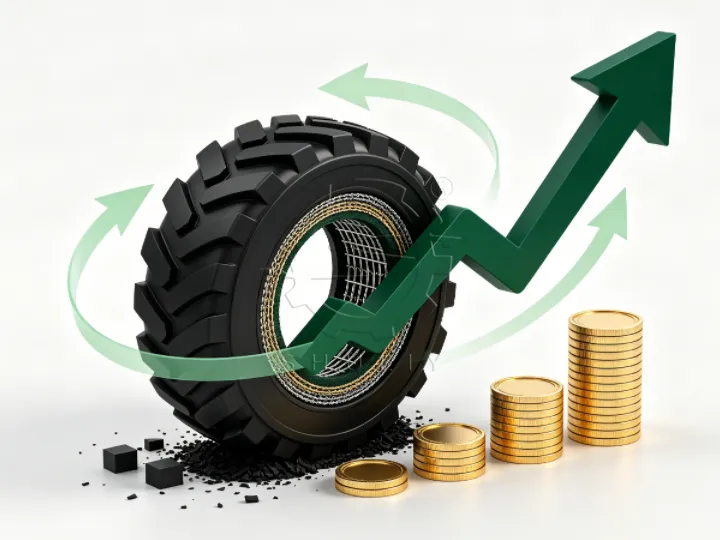
A scrapped 4-ton mining tire is either a $1,500 disposal liability or a $ 1,600 revenue opportunity—depending on how you process it.
With strict ESG bans and tire fire risks, mines actively pay contractors substantial gate fees just to haul giant tires away. Yet inside every 4-ton haul truck tire sits 2.4 tons of premium natural rubber and 800 kg of high-tensile steel.
Investing in a dedicated OTR tire recycling plant bridges this gap, turning environmental liabilities into high-purity 10–40 mesh rubber powder with realistic payback periods of under 12 months.
Here is the no-nonsense financial breakdown: real equipment setup costs (CAPEX), daily operating expenses (OPEX), and net profit projections.
1. The Anatomy of Value: What Is a Scrap OTR Tire Actually Worth?
Unlike passenger car tires—which are dominated by synthetic polymers, carbon black fillers, and lightweight fabrics—mining and earthmover tires are fundamentally different beasts.
Because mining vehicles require extreme load-carrying capacity, low rolling heat generation, and puncture resistance over sharp aggregate, OTR tires are composed of up to 60–70% premium natural rubber (NR) by rubber hydrocarbon content.
| Material Component | Weight Proportion | Net Weight |
|---|---|---|
| High-Purity Natural Rubber (Tread & Plies) | ~60% – 65% | 2,100 kg |
| High-Carbon Steel Wire (Bead Coils & Belts) | ~20% – 25% | 700 – 875 kg |
| Nylon / Synthetic Cord Textile | ~5% – 8% | 175 – 280 kg |
| Contaminants (Embedded rocks, dirt, moisture) | ~2% – 5% | 70 – 175 kg |
Why OTR Crumb Rubber Commands a Market Premium:
When pulverized down to 10–40 mesh (0.63–2.5 mm), rubber powder derived from giant OTR tires sells for 15% to 30% more on the open commodity market than passenger car crumb rubber. Its higher natural rubber content yields superior elasticity, tensile strength, and recovery properties, making it the preferred feedstock for:
- Crumb-Rubber Modified Asphalt (CRMA): High-traffic heavy haul roads and interstate highway paving.
- Heavy Mining Conveyor Belting & Wear Liners: Remanufactured using devulcanized reclaimed rubber.
- Molded Industrial Goods: Heavy machinery anti-vibration pads and high-durability rubber tiles.
2. The Comprehensive ROI Model: Let’s Run the Real Numbers
To evaluate the feasibility of an OTR tire recycling plant, let’s run a standard economic model based on a medium-scale processing line operating 10 metric tons per day (processing approximately three to four 3-ton giant tires daily), running 250 operating days per year (2,500 metric tons/year).
(Note: The following financial modeling reflects average global benchmarks as of 2025. Exact local energy tariffs, scrap steel rates, and gate fees will vary.)
A. Revenue Projections (Per Metric Ton of OTR Tires Processed)
A properly engineered OTR tire recycling plant creates three distinct income channels:
- Gate / Tipping Fees (Mine Disposal Surcharge):
- Mining companies pay licensed operators to take custody of decommissioned tires.
- Conservative Estimate: 150 / metric ton (In North America & Australia, this often exceeds 300/ton).
- Rubber Powder Sales (10–40 Mesh, >99% Pure):
- From 1 metric ton of OTR tires, you yield approximately 600 kg of purified crumb rubber.
- Average Global Market Price: 380/metricton\rightarrow*228 / ton of processed tire.
- Clean High-Carbon Scrap Steel Wire:
- Thick OTR bead coil steel is high-value, heavy melting scrap, purchased directly by steel mills.
- Yield: ~220 kg of steel per ton of tire.
- Average Scrap Steel Price: 250/metricton\rightarrow*55 / ton of processed tire.
Total Gross Revenue Per Metric Ton=$150+$228+$55=$433 /ton
B. Operating Expenses (OPEX per Metric Ton)
Generating high-purity crumb rubber requires mechanical energy, labor, and wear-part replacement. Here is how ongoing operational costs break down in a standard OTR tire recycling plant:
- Electricity & Power Consumption:
- Primary shearing, heavy shredding, fine water-cooled grinding, and pneumatic separation consume an average of 180–220 kWh per ton processed.
- At an average industrial power tariff of 0.10/kWh\rightarrow∗20.00 / ton.
- Direct Plant Labor:
- A modern line requires 3 skilled operators per shift.
- Allocated labor cost→ $25.00 / ton.
- Consumables & Blade Maintenance (Cr12MoV Tool Steels):
- Shredder knife hardfacing, grinding roller re-grooving, and routine lube oil.
- Budgeted wear allowance→ $18.00 / ton.
- Logistics, Forklifts & Facility Overhead:
- Site handling, equipment amortized maintenance, and insurance→ $15.00 / ton.
Total Operating Expense (OPEX) Per Ton=$78.00 /ton
C. The Bottom Line: Net Profit and Payback Period
Net Operational Margin Per Ton=$433 (Revenue)−$78 (OPEX)=$355 /metric ton
Now, let’s aggregate this across an annual production schedule of 2,500 metric tons/year:
| Financial Metric | Value (USD) |
|---|---|
| Total Gross Annual Revenue | $1,082,500 |
| Total Annual Operating Costs (OPEX) | $195,000 |
| Net Operating Profit Before Tax (EBITDA) | $887,500 |
| Typical Turnkey OTR Tire Recycling Plant CAPEX (Equipment) | $450,000 – $750,000 |
| Estimated Full Capital Payback Period | 7 to 12 Months |
The Takeaway: Even if you eliminate the tipping fee entirely (0 gate fee) and accept raw tires for free, the net profit per ton remains an attractive $205/ton, delivering an annualized net profit of over $510,000 on a 2,500-ton processing volume.
3. What Destroys ROI in OTR Recycling (And How to Prevent It)
While the profit potential looks exceptional on paper, the commercial landscape is littered with failed tire recycling facilities. In our 20+ years of manufacturing heavy processing equipment at Shuliy Machinery, we have observed two critical design mistakes that ruin plant profitability:
Mistake 1: Attempting to Shred Whole OTR Tires Directly
Some recyclers buy a generic high-horsepower shredder and drop whole 3-ton mining tires into the hopper.
- The Financial Penalty: The high-tensile bead coil—often 15 cm thick—instantly chips alloy blades, bends rotor shafts, and creates severe shock loads that blow out hydraulic gearboxes. Operators end up spending 15,000 to 30,000 on blade welding and replacements every few weeks, completely eroding their margins.
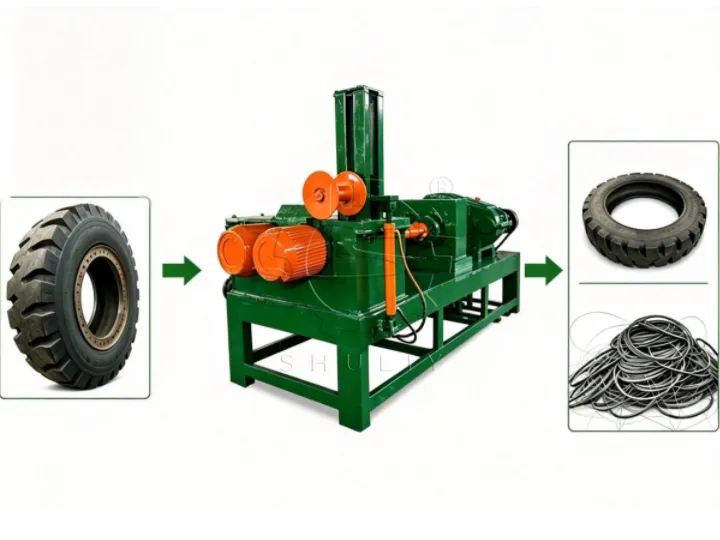
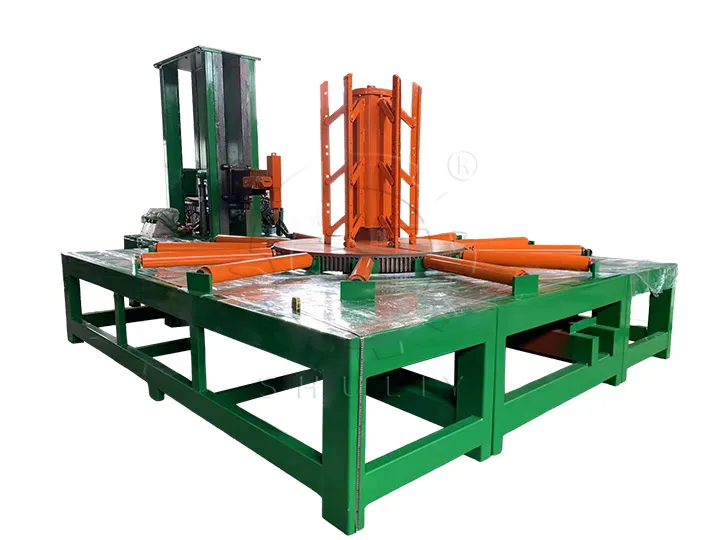
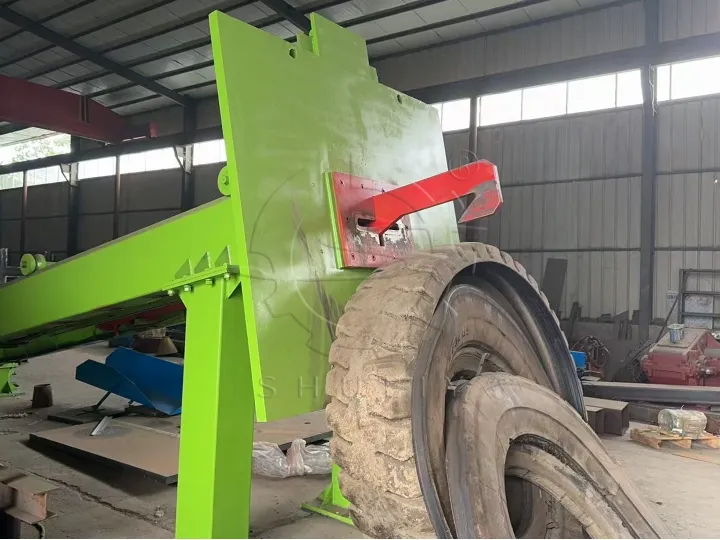
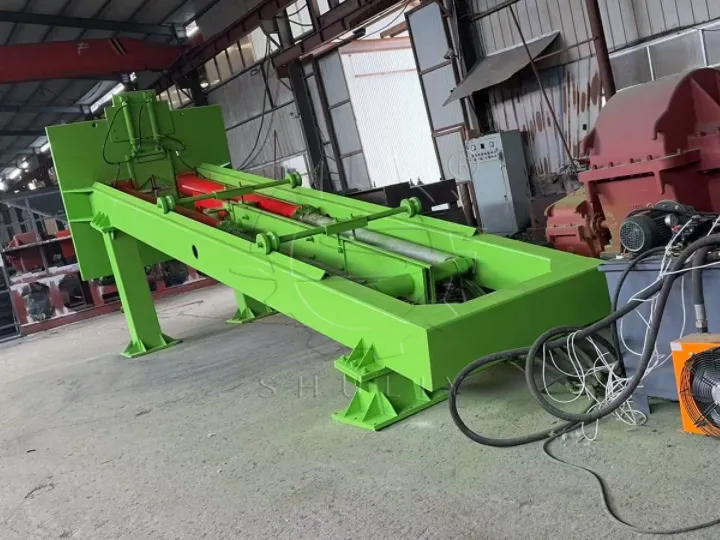
- The Shuliy Engineering Safeguard: Our OTR tire recycling plant enforces front-end mechanical debeading. Using either a high-pressure hydraulic drawing hook or a 3-axis rotary dismantler, we extract the intact bead coil first. This single step extends the operating life of your downstream shredder blades by more than 300%.
Mistake 2: Overheating During Fine Powder Grinding
To sell crumb rubber to modified asphalt producers or export buyers, the powder must retain its elasticity and pass strict sieve analysis without thermal oxidation (scorching).
- The Financial Penalty: If your roller mills lack advanced heat dissipation, the friction of grinding dense OTR rubber elevates temperatures past 120°C. The rubber turns sticky, emits foul odors, and partially vulcanizes, rendering it unmarketable or slashing its sales price by half.
- The Shuliy Engineering Safeguard: Every fine grinding unit integrated into a Shuliy OTR tire recycling plant is built with double-walled, chilled cast-alloy rollers equipped with continuous closed-circuit internal water-cooling, keeping milling temperatures strictly below safe thresholds.
4. Selecting Your Plant Configuration: CAPEX vs. OPEX Tradeoffs
Depending on your available capital and site infrastructure, Shuliy designs your OTR tire recycling plant around two proven configurations:
| Comparison | Configuration A – Hydraulic Shearing Line | Configuration B – 3-Axis Rotary Dismantling |
|---|---|---|
| CAPEX | Moderate ($$) | Slightly Higher ($$$) |
| Mejor para | Mixed heavy OTR tires (1.4m – 3.5m) | Giant haul truck tires (Up to 4m+) |
| Operating Mode | Heavy hydraulic guillotine cutting | Precision rotary slicing of bead & tread |
| Blade Wear | Low (bead wire extracted first) | Ultra-Low (shreds bead-free rubber slabs) |
| Maintenance | Simple hydraulic maintenance | Automated machine-tool operation |
- Go with Configuration A if you operate a regional solid waste center receiving unpredictable mixtures of loader, tractor, and medium-sized haul truck tires.
- Go with Configuration B if you are situated directly on a major mine concession processing uniform giant haul truck tires (e.g., Cat 777 to 797 sizes) and want the lowest ongoing consumable costs per ton
5. Summary Checklist: How to Kickstart Your OTR Tire Recycling Feasibility Study
Before purchasing equipment, any serious investor or plant manager should secure answers to the following operational variables:
- Feedstock Audit: What is your guaranteed monthly tonnage, and what are the maximum tire diameters? (Are they mostly 27.00R49 or giant 59/80R63s?)
- Local Offtake Agreements: Can you secure preliminary Letters of Intent (LOI) with local asphalt batching plants, rubber flooring makers, or scrap metal brokers?
- Power Availability: Does your industrial site have sufficient electrical infrastructure (typically 250 kW to 600 kW depending on plant capacity)?
- Site Licensing & Fire Permits: Have you initiated the environmental approvals necessary to store end-of-life tires on-site?
Plan Your OTR Tire Recycling Plant with Shuliy Machinery
A profitable OTR tire recycling plant requires more than heavy steel; it demands tailored mechanical engineering that protects your balance sheet from excessive maintenance downtime.
At Zhengzhou Shuliy Machinery Co., Ltd., we provide turnkey solutions—from custom foundation civil drawings and electrical control cabinets to on-site commissioning and lifetime wear-part support. Our OTR processing installations in Canada, Australia, and Indonesia are proof of our field reliability.