Tire Recycling Business Profit: A Realistic ROI Calculation for Rubber Powder Producers
Before investing in a tire recycling line, every buyer asks the same question: will this pay for itself, and how fast? The…
Before investing in a tire recycling line, every buyer asks the same question: will this pay for itself, and how fast?
The short answer is yes — the industry’s typical gross margins of 25–50% and common payback periods of 12–24 months make it a proven business model. The better answer is that tire recycling business profit is not a fixed number. It is a simple formula you can calculate for your own city in about ten minutes:
(Revenue per ton − Cost per ton) × Tons per month = Monthly profit
This guide walks through that formula step by step: where the money comes from, the costs most buyers forget, a realistic worked example, and how to estimate your payback period. You can copy the numbers below and replace them with your local prices.
Where the Money Comes From: 3 Revenue Streams
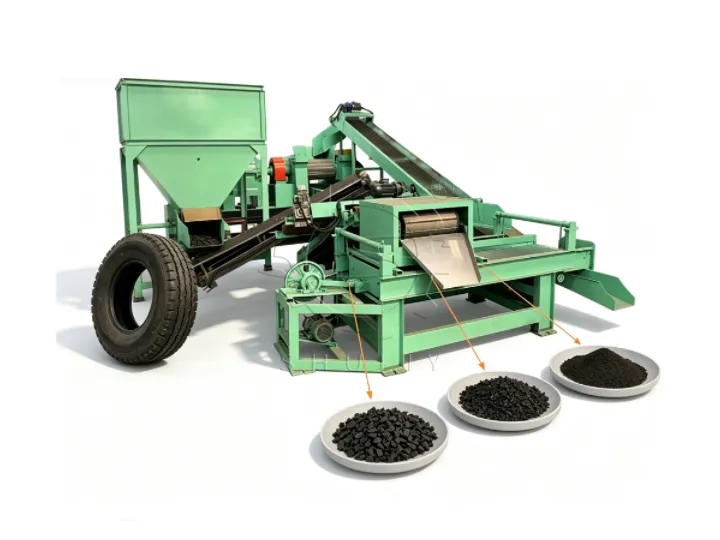
A scrap tire is not a single material — it is a package of three saleable products:
- Резиновый порошок — the main income. The rubber powder price per ton typically ranges from around $250 for coarse granulate to $600+ for fine 40-mesh powder, depending on your market.
- Стальная проволока — removed by the magnetic separator and sold to steel mills or scrap dealers.
- Nylon fiber — a smaller but real income stream, often sold as filler material.
A useful rule of thumb: rubber powder brings in 70–80% of your revenue, while steel and fiber make up the rest. That is why purity matters so much — the cleaner your powder, the higher the price it commands, and the more repeat customers you keep.
What 1 Ton of Scrap Tires Is Really Worth
Here is a realistic breakdown of one ton of passenger-car tires processed through a rubber powder production line:
| Output | Amount per ton | Example price | Value |
|---|---|---|---|
| Резиновый порошок | 600 kg | $320 / ton | $192 |
| Стальная проволока | 200 kg | $200 / ton | $40 |
| Nylon fiber | 70 kg | $80 / ton | $5.6 |
| Total revenue | ≈ $238 / ton |
Two notes. First, these are example prices — your local rubber powder price per ton may be higher or lower. Second, finer mesh sells for more but reduces throughput, so your target mesh should match the best-paying demand in your area rather than the finest possible size.
The Costs Most Buyers Forget
Most people only compare the tire recycling machine cost. The real calculation includes operating costs per ton:
| Cost item | Example | Notes |
|---|---|---|
| Scrap tire purchase | $60 / ton | Can range from $0 to $100; some regions even pay you to take tires |
| Electricity | $5 / ton | About 40 kWh per ton at $0.12 / kWh |
| Labor | $12 / ton | A semi-automatic line needs only 2–3 operators |
| Wear parts & maintenance | $8 / ton | Rollers, screens, conveyor belts |
| Facility, packing, sales, admin | $18 / ton | Often underestimated by first-time buyers |
| Total operating cost | ≈ $103 / ton |
On top of that comes the one-time investment: the machine itself, plus freight, customs and installation — which can add 15–30% to the equipment price. This is the figure you divide into your monthly profit, so do not leave it out.
A Realistic Tire Recycling Business Profit Calculation
Using the example above, one ton of tires gives you roughly:
$238 revenue − $103 cost = $135 net profit per ton
Now scale it by line capacity and running hours. The table below shows three typical setups (Shuliy lines range from 80 kg/h to 2300 kg/h, semi-automatic or fully automatic):
| Scenario | Typical line | Monthly output | Net profit / month (example) | Total investment* | Payback, on paper | Payback, realistic |
|---|---|---|---|---|---|---|
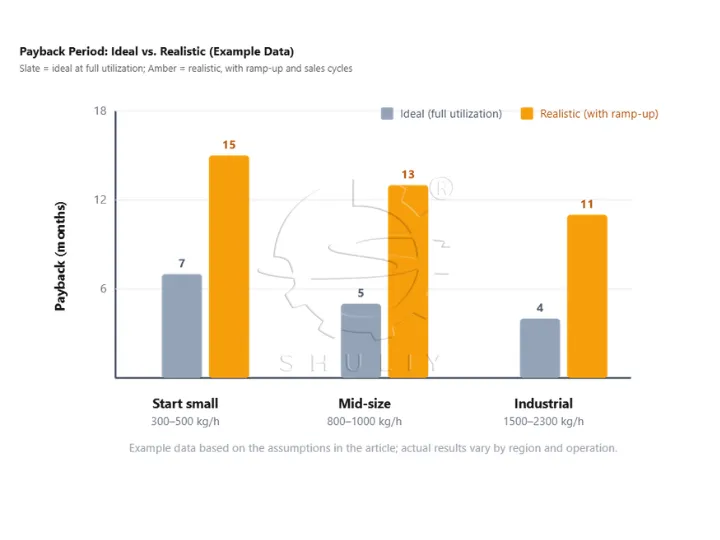
| Start small | Semi-auto, 300–500 kg/h | ~104 t | ~$14,000 | ~$90k | ~7 months | 12–18 months |
| Scale up | Semi-auto, 800–1000 kg/h | ~333 t | ~$45,000 | ~$220k | ~5 months | 10–16 months |
| Industrial | Full-auto, 1500–2300 kg/h | ~1,040 t | ~$140,000 | ~$520k | ~4 months | 8–14 months |
*Including machine, freight, customs and installation.
Why the Realistic Number Matters
The “on paper” payback assumes 100% utilization and instant sales. In reality, every new plant goes through a ramp-up period: you need to secure steady feedstock, find buyers for the powder, and reach stable uptime. This is why most well-run facilities report a full payback in 12–24 months — a figure consistent with industry reports — rather than the optimistic 4–7 months.
The formula stays the same: Payback period = Total investment ÷ Monthly net profit. If you know your local numbers, you can estimate your own timeline in minutes.
Five Factors That Decide Your Real Payback
- Purity of the powder. Powder with 99%+ purity and almost no steel residue sells at a premium and keeps buyers coming back. A built-in magnetic separator removes steel during grinding — this single feature protects your price.
- Mesh selection. Selling 10-mesh granulate when your market pays most for 40-mesh powder leaves money on the table. Choose a line with adjustable screens.
- Энергопотребление. At 40 kWh per ton, electricity is a small line item; conventional machines using 30% more power quietly eat into the same profit.
- Roller life. Grinding rollers are the part that wears fastest. Alloy rollers such as 5Cr6MnMo steel last far longer than cast iron — Shuliy backs them with a 3-year warranty — which means fewer shutdowns and lower wear-part spend.
- Operating hours. Running one shift instead of two roughly halves your payback speed. Capacity should be chosen for the hours you can actually run, not the theoretical maximum.
Get a Custom ROI Estimate for Your Plant
The fastest way to turn this guide into your own бизнес по переработке шин profit forecast is to send us four numbers:
- Your local scrap tire price per ton
- Your electricity rate
- Your target rubber powder mesh
- Planned running hours per day
Our engineers will prepare a free, custom calculation for your situation and recommend the right rubber powder production line — from 80 kg/h workshop models to 2300 kg/h fully automatic lines. Shuliy has exported recycling equipment to 60+ countries, with CE/ISO-certified manufacturing, on-site installation and operator training included. Contact us with your figures and get your payback estimate before you commit.
Часто задаваемые вопросы
Is tire recycling profitable?
Yes, for most operators. Gross margins of 25–50% are common in the industry, but your local feedstock price, electricity cost and target market decide the final number.
How much can you make recycling tires?
Using the example model above, net profit is around $135 per ton after all operating costs. Monthly income then depends on line capacity and running hours — from about $14,000/month on a small semi-automatic line to $140,000/month on an industrial line.
What is the payback period for a tire recycling machine?
Typically 12–24 months for well-run plants. It shortens with cheap feedstock, high utilization and a ready buyer for the powder.
How much does a tire recycling machine cost?
It varies widely with capacity and automation. More important than the machine price is the total investment — remember to include freight, customs and installation in your payback math.